In-house, agency, or freelancer: what each actually costs you at seed round
You need one senior product designer with a founding mindset, long term, who behaves like a member of the team. Here are the three ways to get that person, what each really costs, and what goes wrong with each.

Key takeaways
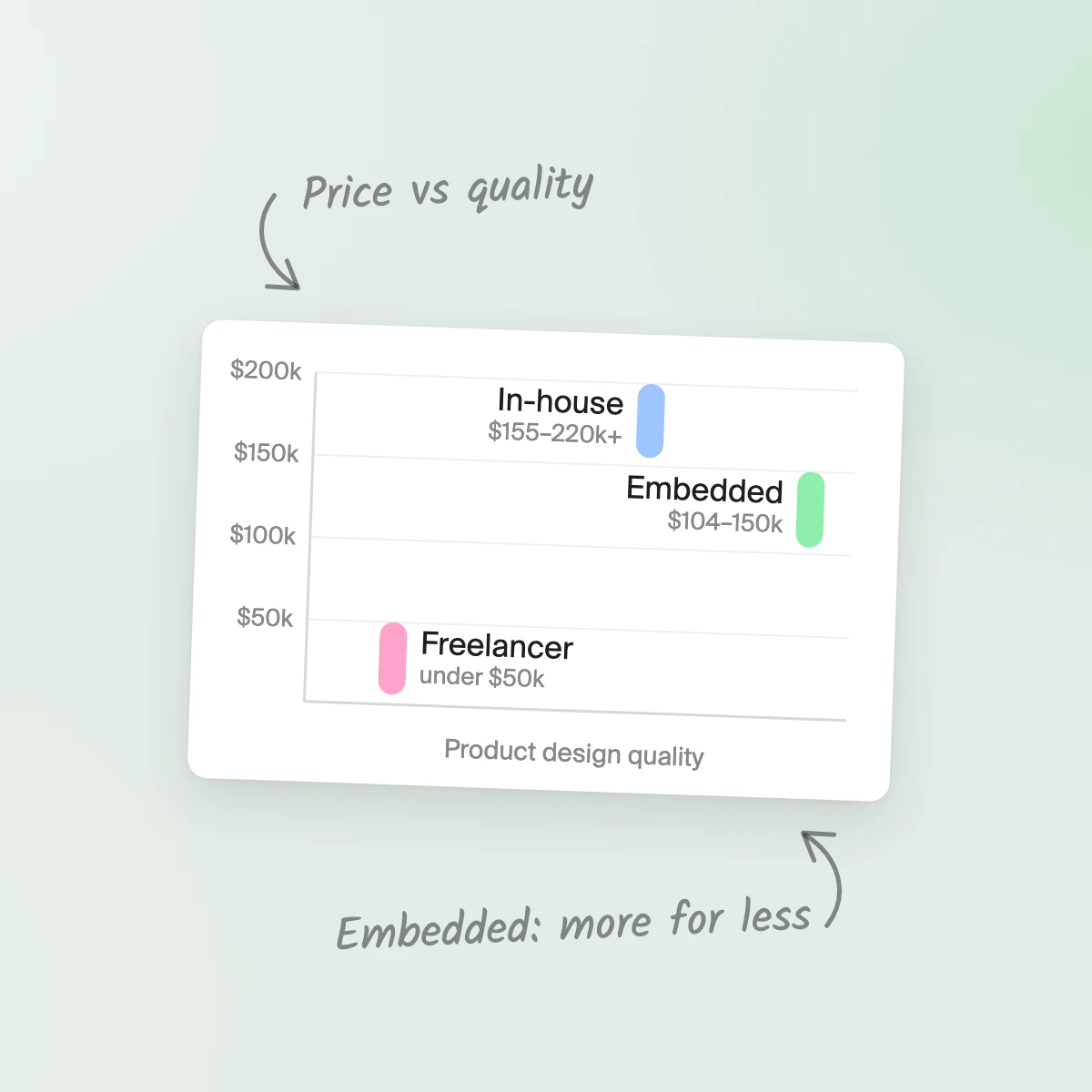
- Above roughly $150,000 a year with a settled direction, hire in-house; between $50,000 and $150,000, a studio or an experienced freelancer gets you further; below $50,000 you are buying part-time freelance hours.
- A $100,000 in-house designer is realistically $155,000 to $165,000 in year one, arriving in month four or five.
- A freelancer is cheapest to start and most exposed: nobody reviews the work, covers for them or is accountable if they stop replying.
- With a studio the invoice is the cost: ask how many projects the designer works on, who pays for a handover, and how long until someone starts.
If you can budget above roughly $150,000 a year and your direction is settled, hire in-house. Between $50,000 and $150,000, a studio or an experienced freelancer will get you further than a hire will, and which of the two depends on whether you need someone in the room or someone on call. Below $50,000, you’re buying part-time freelance hours, and you should plan around that rather than pretend otherwise.
The rest of this is how those numbers work and what breaks in each case.
Who this is for
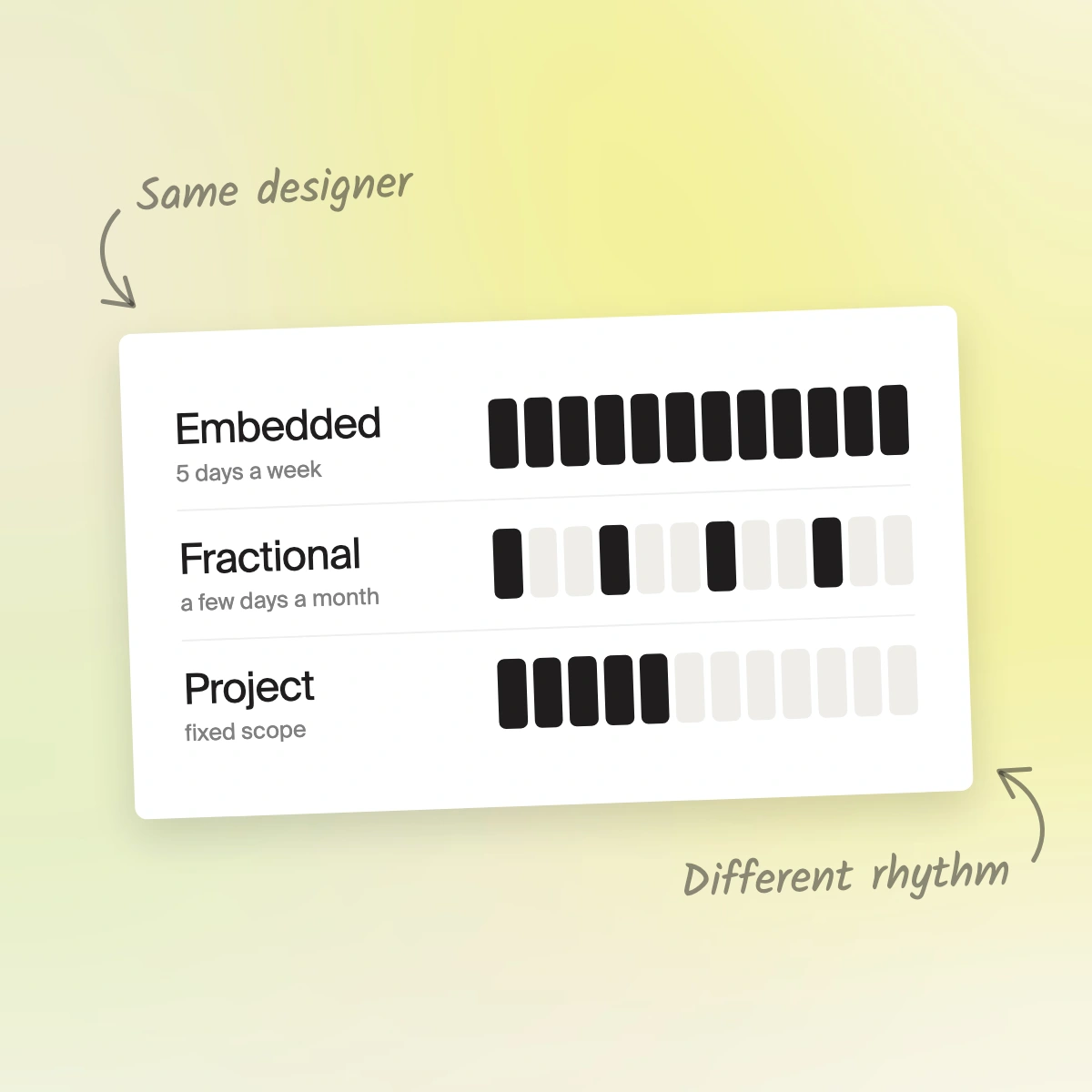
One specific situation: you need a single senior product designer for at least three months and probably a year or more. Often the only designer in the company. Someone who joins the important meetings, holds ownership of the product’s design, stays in context, brings things up before you ask, and ships quickly at a quality you don’t have to check.
Founders describe this to me as wanting someone with a founding mindset, and that’s accurate. It’s also the most competitive profile on the market right now. In Figma’s State of the Designer 2026 survey, 56% of hiring managers reported rising demand for senior designers against 25% hiring more juniors. Everybody wants this person. That matters for everything below.
If what you need is a queue of defined tasks, a bounded redesign, or a second pair of hands for six weeks, this is the wrong article. Those are different models with different economics, and the pillar piece covers them.
What your budget actually buys
Design cost benchmarks are mostly written by people selling design, ours included, so start from the constraint rather than the price list.
Under about $50,000 a year
This does not buy a full-time senior anywhere in the world. Freelance senior product designers average around $95 an hour globally, with senior rates commonly quoted between $130 and $180 in the US market. At those rates, $50,000 is roughly ten hours a week. That’s a real and useful arrangement, but be honest with yourself about what it is: you’re buying execution capacity, not someone with a founding mindset. A person working ten hours a week for you cannot hold context on a product that changes weekly, no matter how good they are.
$50,000 to $100,000
Part-time freelance at a decent volume, part-time engagement with a studio, or a full-time in-house senior in Central and Eastern Europe, where senior product designer salaries in Poland run roughly $42,000 to $65,000 (155,000 to 240,000 złoty) before employer costs.
$100,000 to $150,000
Full-time appears. A studio embedded designer sits here. So does an in-house senior in much of Western Europe: a senior product designer in Germany averages around €74,000 base, which lands near $105,000 once employer costs are added.
Above $150,000
This is where a US in-house hire becomes possible at all. A senior product designer in the US averages around $160,000 base, and that’s before anything else on this page.
One more piece of arithmetic worth doing. US agency hourly rates for senior boutique and enterprise work run $150 to $300, and European agencies $100 to $250. A year of full-time-equivalent work at $250 an hour is somewhere north of $400,000. Those rates are real, and they’re simply not a seed-stage conversation. If you’re being quoted them, you’re being quoted enterprise pricing for a startup problem.
In-house: the number on the offer letter is not the cost
Hiring is the right answer more often than agencies admit. It’s also the option where the advertised price is furthest from the real one, so this section has the most arithmetic in it.
Say you’re hiring at $80,000 to $120,000, which is a realistic band outside the top US metros.
Add employer costs
Payroll taxes run roughly 8 to 12% of wages, and benefits add around 30% of total compensation. The standard planning multiplier is 1.25 to 1.4 times base salary, higher for generous packages. Take 1.4 as a working figure: a $100,000 salary is about $140,000 a year of actual cost.
Add the cost of finding them
Running the search yourself lands around $9,000 to $25,000 once you count sourcing, tooling, and the hours your team spends interviewing. Hand it to a recruiter and placement fees are typically 15 to 25% of first-year salary, so $15,000 to $30,000 on a $120,000 role.
Add the time
Filling a design role through a conventional search takes 45 to 60 days. Then the person ramps: four to eight weeks to independent output, two to three months where they need to become fluent in an existing system. Call it four to five months from deciding to hire to having someone productive.
Then the risk you can’t insure
A bad hire costs somewhere between 50% and 200% of the salary once you count severance, lost time, and redoing shipped work. Design is unusually exposed here, because portfolio quality and fit with your specific product are hard to judge in a few conversations, and you often don’t find out until a quarter of the work needs redoing.
So a $100,000 designer is realistically $155,000 to $165,000 in year one, arriving in month four or five, with a meaningful chance of being the wrong person. In the US, where senior base averages $160,000, the same maths puts year one comfortably past $220,000.
None of that makes hiring wrong. It makes hiring a commitment rather than a purchase.
When in-house is clearly right
Your direction is locked, you have twelve months of budget for the role, the work is continuous, and somebody around you can evaluate design well enough to pick the right person and tell whether the work is going well. That last condition is the one teams skip. If nobody in the company can do it, you’re choosing blind and then managing blind, and the failed-hire number above is the price of that.
How to de-risk it
Get someone with design expertise into your interview loop even if you have to pay them for a day. Run a paid trial project rather than a portfolio review. Hire on a contract-to-hire basis if you’re honestly unsure the role is permanent. And write down what you expect to be true in six months before the person starts, so you have something to evaluate against later.
Freelancer: cheapest to start, most exposed
A freelancer is often the correct answer, and agencies are bad at saying so. If your budget is genuinely under $50,000 a year, it’s the only answer that isn’t a fantasy.
The cost
Roughly $90 to $130 an hour for mid-to-senior work, and $130 to $180 for senior designers with real depth in your domain, the ones who lead product decisions rather than execute them. Specialists go higher again. No employer costs, no recruiting fee, no notice period. You can start next week.
What actually goes wrong
The failure modes are consistent. They take on more work than they can hold and your project quietly becomes the one that slips. They’re unavailable in the week you need them. They disappear. Occasionally there’s an NDA or IP problem that only surfaces when you try to raise.
The structural issue underneath all of those is that a freelancer has no institution behind them. Nobody reviews the work, nobody covers when they’re sick, and nobody is accountable if they stop replying.
How to de-risk it, concretely
A written contract with NDA and explicit IP assignment before any work starts, not after. Payment tied to milestones rather than monthly in advance. An agreed number of overlapping working hours per week, written down. Files living in your workspace and your repository, not theirs, so a disappearance is an inconvenience rather than a catastrophe. And a small paid trial before you commit to anything long.
When it’s right
You have someone internally who can brief and evaluate, the work has enough definition to hand over, and your budget genuinely doesn’t reach full-time. Also when you want to test whether design moves anything for you before committing a year of salary to it.
Studio: the model, and the fear that comes with it
A studio sells you the same senior person, plus a structure behind them. What you’re paying extra for is that structure, so it’s worth being precise about whether it exists.
The cost
Our embedded model starts at $2,000 per sprint week, invoiced every four weeks with a four week minimum. That’s from about $104,000 a year. It’s a “from” price: a harder brief, more people, or a specialist profile costs more.
Where that lands depends entirely on where you’d otherwise hire. Our designers are in Europe, so against a US in-house hire we come out comparable or cheaper once employer costs and recruiting are counted. Against a European or CEE hire, we’re clearly more expensive. Any studio telling you it’s cheaper than hiring everywhere is comparing against one market and not telling you which.
What you don’t pay on top: no payroll taxes, no benefits, no recruiting fee, no severance, no cost of the search.
The invoice is the cost.
That’s the whole difference between the two columns, and it’s why the comparison people make in their head (salary versus retainer) is wrong by 40 to 60%.
The fear
You’ll be sold engagement on a call, and then get a designer who is running four other projects and treating yours as one of them.
That fear is correct and common, and it cannot be answered with another promise on another call. So here are the questions that actually test it. Ask them of any studio, including us.
How many projects does this designer work on?
If the answer isn’t one, ask what the split is and whether it’s contractual. At Other Land, an embedded designer works on one project. That’s what the model is.
Whose time is not dedicated, and how much of it do we get?
Every studio has people whose time is shared. At ours it’s me and Lily, our design director: our hours are split across the whole studio, and we commit to a minimum of two hours each per week on your project. I’d rather write that down than imply we’re always available.
Can we meet the actual designer before signing?
If a studio can’t name and introduce the person, they haven’t decided who it is yet.
How is the designer chosen?
Availability or fit? We’ve been running this model for over five years and have placed designers into around 60 products, from a pool of more than 40 people. That’s the reason we can match on relevant domain experience rather than on who happens to be free, and it’s the single biggest quality difference between studios of this kind.
What happens if the designer doesn’t work out or leaves?
Ours is two weeks’ notice, a replacement offered immediately, and an overlap period where the new designer is onboarded at our cost rather than yours. Ask specifically who pays for the handover, because that’s where the answer gets vague.
How long until someone starts?
For us it’s one to two weeks: contract, access, materials, and internal setup. Compare that to four to five months for a hire and it’s most of the argument for this model.
What’s the notice period?
Two weeks, both directions. If you’re being asked for a quarterly or annual commitment, that’s a different product, and it should be priced as one.
Are the designers senior, and does the work get handed to juniors?
Ask who actually opens the file. We staff senior designers only and don’t hand execution down.
When a studio is right
The work is continuous and shapes what gets built, you need someone in the room within weeks rather than months, nobody internally can evaluate design well enough to hire safely, and you’re not certain enough about the next twelve months to commit to a permanent role.
When it isn’t
You have the budget and the certainty and someone who can hire well. Then hire.
The premium a studio charges is insurance against uncertainty, and there’s no reason to buy insurance you don’t need.
Where we don’t fit
If you have less than roughly $50,000 a year for design and you need the product actively improved, we’re out of range and a freelancer will do more for you than we will. Our cost structure doesn’t compress that far, because senior designers are expensive and there’s a design lead and a project manager attached to every account by construction.
If you need a queue of defined marketing tasks rather than product judgment, a design subscription is cheaper and better suited.
And if your direction is settled, you have a year of budget, and someone in the company can hire a designer well, the honest answer is that you should hire one.
The questions founders ask me before deciding
Is an agency cheaper than hiring a designer?
It depends entirely on where you’d hire. Against a US senior hire, an embedded studio designer is usually comparable or cheaper once you add employer costs of 1.25 to 1.4 times salary plus $9,000 to $30,000 of recruiting. Against a hire in Central or Eastern Europe, a studio is clearly more expensive.
What does a designer actually cost beyond salary?
Plan on 1.25 to 1.4 times base for payroll taxes and benefits, plus recruiting, plus four to eight weeks of ramp before independent output. A $100,000 salary is realistically $155,000 or more in year one.
How long does it take to get a designer working?
A conventional hire takes 45 to 60 days to fill plus four to eight weeks to ramp. A studio designer typically starts within one to two weeks. A freelancer can start immediately.
When should we hire in-house instead of working with a studio?
When the direction is locked, there’s twelve months of budget, the work is continuous, and someone in the company can evaluate design. If any of those four is missing, a studio or a freelancer is the lower-risk route.
We only have about $50,000 a year. What can we get?
Roughly ten hours a week of senior freelance time. Plan the work around that constraint rather than expecting someone to behave like a full-time team member.